Showing posts with label NYRB Reading Challenge. Show all posts

Sunday, January 16, 2011

NYRB Contest Winner. . .


Thanks to everyone who entered my NYRB contest - it was a lot of fun seeing which books on their fabulous spring list people were most interested in reading.  I wish I could have rewarded you all, but there can only be one winner.  So congratulations to Natalie F. 
Just for fun, I compiled all your votes for the books you most wanted to read.  Every single book on the spring list got multiple votes which just goes to show how astute an editorial eye NYRB has - they really do publish books for every reading taste.  The backlist requests covered numerous titles, but the one most often requested was Richard Burton's The Anatomy of Melancholy, which is also one of their biggest books (not sure if there is a correlation). The top three most anticipated books from the spring list were:

#3.  Dead Souls by Nikolai Gogol, translated by Donald Rayfield
A new translation of this great Russian classic.

#2.The Three Christs of Ypsilanti by Milton Rokeach
A fascinating true story about three paranoid schizophrenics who all believed they were Christ and were brought together to live for two years to argue and debate amongst themselves

And overwhelmingly,
the #1 favourite was . . . 
 
 
Fair Play by Tove Jansson, translated by Thomas Teal
The story of two women, both artists who live, work, love, and argue from opposite sides of a large apartment building. Jansson is one of my favourite NYRB authors - no one is better at writing about complicated women's relationships.

Tuesday, January 4, 2011

NYRB Giveaway. . .

I promised a giveaway to celebrate finishing my 50 book NYRB challenge and I'm going to let YOU choose your own prize.  I mentioned that NYRB Classics has an amazing spring list which I'm listing below.  Pick the three books that you'd most like to read from the Spring list, plus two books from their backlist (browse it here) and a lucky winner will get all five plus a snazzy NYRB totebag.  Send me an e-mail at mscott@randomhouse.com  with NYRB in the subject line,  and a list of the 5 books. I'll throw all the names into a hat and pull out the winner. This contest is open to those living in Canada and the U.S. only.  For Canadian readers, please note that several NYRB titles are not available for sale in Canada and so I can't include it in your prize.  If the title doesn't show up on www.randomhouse.ca  then it isn't available in Canada.  Deadline for entering is January 15th, 2011.  NOTE:  This contest is now closed.

So without further ado, here's some of the amazing NYRB books to look forward to this spring. I guarantee there's something for everyone:


The Traveller's Tree by Patrick Leigh Fermor
An exploration of the Caribbean islands by one of the twentieth century's greatest travel writers.

The Doll by Boleslaw Prus, translated by David Welsh
An ambitious classic of Polish literature, a story of money, love and class set in the 19th century Warsaw.

The Ice Trilogy by Vladmir Sorokin, translated by Jamey Gambrell
Contains Bro, Ice and 23,000 - the three parts of Sorokin's trilogy recounting the escapades of the Brotherhood of Light, a group of homicidal fanatics in gritty, violent, contemporary Moscow.

Irretrievable by Theodore Fontane, translated by Douglas Parmee
The story of a couple, happily married for twenty-three years until a certain tension starts to creep in and they slowly start to drift apart.

The Three Christs of Ypsilanti by Milton Rokeach
A fascinating true story about three paranoid schizophrenics who all believed they were Christ and were brought together to live for two years to argue and debate amongst themselves.

Songs of  Kabir, translated by Arvind Krishna Mehrotra
A collection from the Northern India philosopher, satirist and oral poet Kabir, who lived from 1398-1518.

We Think the World of You by J.R. Ackerley
A new unexpurgated edition of this dark "fairy tale for adults", as Ackerley described it.  From the author of My Dog Tulip.  And yes, this also features a German shepherd.


Fair Play by Tove Jansson, translated by Thomas Teal
The story of two women, both artists who live, work, love, and argue from opposite sides of a large apartment building.  Jansson is one of my favourite NYRB authors - no one is better at writing about complicated women's relationships.

Dancing Lessons for The Advanced in Age by Bohumil Hrabal, translated by Michael Henry Heim
An elderly rake recounts his life story to a group of sunbathing women who remind him of lovers past.  The whole novel unfolds in one single sentence (don't panic, it's not that long -the book, not the sentence).

The Pumpkin Eater by Penelope Mortimer
A surreal, black comedy about the mother of countless children from several marriages and her relationship with a successful screenwriter.

Fatale by J.P. Manchette, translated by Donald Nicholson-Smith
Aimee is a drop-dead gorgeous professional killer who has set her eyes on a backwater town where she plans to manipulate old grudges and play people against each other. A modern detective novel filled with farce and anarchy.

Dead Souls by Nikolai Gogol, translated by Donald Rayfield
A new translation of this great Russian classic.

When the World Spoke French by Marc Fumaroli, translated by Richard Howard
From the death of Louis XIV to the Revolution, French was the universal language in Europe. A series of portraits of political and intellectual foreigners who conversed in French regardless of their native language.

Monday, January 3, 2011

NYRB 50 Book Challenge Wrap-up. . .


Hooray, I did it!  Took a bit longer than I'd estimated, but if you only knew how many reading challenges I set myself up for and abandon halfway, I can't help feeling pretty chuffed with myself.  (List of books read is covered here.)

The worst thing about doing this 50 book challenge is that I've barely scratched the surface of NYRB's terrific backlist (and they keep churning out fanastic new books every year).  Including the NYRBs that I'd previously read, I estimate that I've now read about 75-80 in total.   But I now have over 200 at home in a bookcase. Sigh. And yet, I'd never want them to slow down, because of course the BEST thing about doing this challenge is all the great writers and books I've been introduced to, as well as finally being able to dust off a bit of the gargantuan to-be-read pile.  I was already full of admiration for their editorial and acquisition savvy and fifty books later, this has only increased. And wait until you see their spring list! The biggest surprise was how funny so many of the novels were and how distinctive and original the narrative voices were. My biggest regret is that I didn't tackle as much of their non-fiction list as I'd have liked to, especially some of the travel writing.  And I could have read more women writers - only managed twelve out of the fifty -  although the make-up of NYRB's list is certainly dominated by men. Nevertheless it's been a very worthwhile experience and of course I'll continue to read and blog about NYRB books, although it may be a while before I commit myself to another public reading challenge. Still, I've got my eye next on Melville House's novellas series, classic and contemporary (and another unread couple of shelves at home).
Here are my top ten favourites from this NYRB challenge with links to my reviews  (to add to my previous top ten listed here before I started)

1. Troubles by J.G. Farrell.  I was crushed when we lost Canadian rights on this terrific novel that also won the Lost Booker Prize last year.  You can still get it in Canada from Orion, just not the NYRB edition.  At any rate, regardless of the publisher, just read it!

2. The Book of Ebenezer Le Page by G. B. Edwards.

 3. Everything Flows by Vasily Grossman, translated by translated by Robert Chandler, Elizabeth Chandler and Anna Aslanyan

4. Anglo-Saxon Attitudes by Angus Wilson

5. Cassandra at the Wedding by Dorothy Baker

6. The Jokers by Albert Cossery, translated by Anna Moschovakis

7. Skylark by Dezső Kosztolányi, translated by Richard Aczel
8. Wish Her Safe at Home by Stephan Benatar

9. Inverted World by Christopher Priest

10. Original Letters From India by Eliza Fay

And NYRB fans, stayed tuned for a contest and giveaway later this week!

Thursday, December 30, 2010

NYRB Challenge #50: End of the Road. . .


At the beginning of this challenge, I was determined not to read the same author more than once, but then I've broken so many of the guidelines I set out for myself, that I'm not bothered by one more. Simply put, I was completely blown away after reading Everything Flows earlier this year; when NYRB recently published Vasily Grossman's The Roadtranslated by Robert and Elizabeth Chandler and Olga Mukovnikova, I knew it was the book I wanted to end this challenge with.

As expected, this was a very powerful and sometimes difficult (in terms of content) read.  It's a collection of short stories, journalism, essays and two moving letters Grossman wrote to his dead mother on the anniversaries of the 1941 massacre at Berdichev, in which she died. The stories are worthy complements to his journalism being mostly about ordinary people and their reactions - often unexpected - to the horrors of war and living in an occupied town. Several of the stories are about finding a moment of human connection in extraordinarily sad and lonely circumstances.  Two stories try to see the world from an animal's point of view. "The Road" follows the painful experiences of a weary, abused mule, dragging his master's cart over endless, devastated roads during the Second World War. "The Dog" portrays the life of one of Russia's first animals sent into space.

But it is the journalistic pieces that stand out the most.  At the center of the book is the harrowing "The Hell of Treblinka", Grossman's description of what happened, step by step, detailed moment by horrific moment, to the thousands who disembarked the trains at this notorious death camp.  "The Sistine Madonna" ponders the effect of Raphael's painting, which "speaks of the joy of being alive on this earth" juxtaposed against all the wars and horrors that have occured since its creation. There is a reflective essay entitled "Eternal Rest" about people's relationships to cemetaries and the dead.  A passage from this piece sums up many of the themes in Grossman's work, and gives a sense of the complexities he continually finds and explores in human nature - at the best and worst of times:

     Few close relationships are entirely clear and transparent; they are seldom - as it were - linear and single-story.
     More often they are buildings with thick walls and deep cellars, with dark, stuffy little bedrooms, with all kinds of little outbuildings, with extra floors aded on top.
     And there is no knowing all that goes on in these little rooms and cellars, in these little corridors and attics. There is no end to what has been seen adn heard by the walls of these incorporeal structures deep inside the human heart. They have seen clear light, merciless reproaches, eternal lust, satiety to the point of nausea, truth, the desperate wish to hae done with someone once and for all, year upon year of one trivial grievance after another and the need to account for every last kopek. They ahve seen terrible secret hatred. They have seen fights. They have seen blood being drawn. They have seen meekness.
NYRB and Robert Chandler have done a terrific job with this collection, assembling photographs of Grossman, useful introductions to each section which place the pieces in historical and biographical context, and providing detailed scholarly notes, follow-up appendices and even an afterword by Grossman's stepson. It's truly a great tribute to an unrelentingly brave and important writer.

And so, I've finally completed my 50 book NYRB challenge - a few months later than I'd hoped, but better late than never.  I'll assemble my thoughts on the process and list my top 10 favourites shortly.  

Wednesday, December 22, 2010

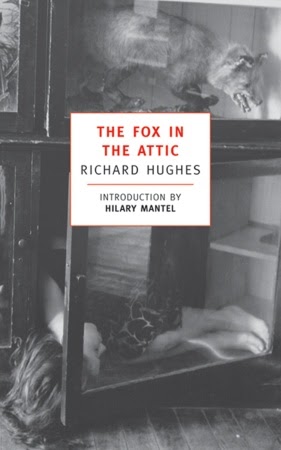
NYRB Challenge #49: The Fox in the Attic. . .

Richard Hughes is best known for his children's pirate adventure tale, A High Wind in Jamaica (also published by NYRB), but The Fox in the Attic is something quite different.

Conceived as the first part in a multi-volume project called "The Human Predicament", it follows the wanderings of Augustine, a young man in his twenties, heir to a large, empty house in a small Welsh town.  It's been five years since the end of the First World War (in which he was too young to fight), but this is not a Mitford or Fitzgerald type story of the jazz age.  Rather, it's a grim look at the lives of several characters - on both sides - struggling with personal tragedies against the still haunting echoes of the war.  The novel opens with Augustine carrying the body of a young six year old girl over his shoulder as if she were game. She has been found dead in the marshes, but by the time he gets her home, she's become something not unlike a corpse in a trench:

This had ceased to be "child" at all: it was total cadaver now. It had taken into its soft contours the exact mold of the shoulder over which it had been doubled and it had set like that - into a matrix of him.  If (which God forbid) he had put it on again it would have fitted.
To escape the village's implications that he might have had more to do with the child's death than just discovering the body, Augustine goes to visit distant German relatives living in a castle not too far from Munich, where he falls in love with his blind cousin Mitzi, distracting him from observing the political tensions swirling in the town.  During his visit, Hitler's failed putsch to seize power in Bavaria occurs, and Hughes devotes an interesting chapter to describing a few days in which an injured Hitler hides out at a friend's house before being captured.  He's not the only fugitive; strange noises are coming from the castle attic and not just from the fox that roams the corridors freely.

This is a rather disturbing book, full of meditations on the nature of self and self-consciousness, wrapped in a narrative of grief and almost hallucinatory madness at times. The very descriptions of the landscapes, whether in the bleak outdoors or in claustrophobic interiors, adds to the gloom and sense of menace that pervades the novel, even though there are a few comic, if macabre moments.  As such, it makes perhaps an interesting companion read to Bruce Duffy's The World As I Found It  (in fact G.E. Moore, or at least his philosophy, even makes an appearance).  It's both an eccentric and enthalling read where the fictional characters are juxtaposed against historical ones but equally distanced from each other so that it never feels contrived. It is very much a novel exploring individual isolation - physical, political, religious and philosophical. Hughes never finished his projected "Human Predicament" but there is a sequel - The Wooden Shepherdess - that continues Augustine's story and includes twelve chapters from what would have been the third book.  The Fox in the Attic reads just fine as a stand alone novel, but I'm intrigued enough both by the narrative and the prose style, that I'll definitely continue the journey.

Wednesday, December 8, 2010

NYRB Challenge #47 & 48: A Lost Love and No Love Lost. . .

I first discovered the marvellous writing of  Stefan Zweig through the NYRB editions of Chess Story and the strange and haunting novel The Post-Office Girl which was a Dewey Diva pick (I reviewed it here.)  So when NYRB's new edition of Journey Into the Past, translated by Anthea Bell, landed on my desk last month, it was a no brainer for this challenge.  The fact that most of this novella takes place on a train, was just a bonus.

Ludwig has returned to Germany after nine years and is travelling with his former employer's wife - a woman he fell in love with all those years ago. The feeling was mutual, but Ludwig was sent to work in Mexico for two years and stuck in North America when the First World War broke out. Now married with children, he's returned for a brief visit, only to find that his love is as strong as ever but the obstacles that separate the two are just as problematic, if different. Zweig has a subtle way of juxtaposing this brief, unconsummated love against the huge historical backdrop of the two world wars (though the second hasn't yet started, there are clear intimations of what is to come). The intensity of emotion between the two lovers is both everything and nothing, insignificant against the tide of political events, and thwarted even by the mundane. They can't even talk in their train compartment because of the entry of noisy companions.  This is a lovely novella of longing, lust and looking back.

The editors at NYRB are clearly attracted to novels featuring strong, sometimes disagreeable, but always original and utterly unforgettable narrative voices. I think of Rachel in Stephen Benatar's Wish Her Safe at Home or Cassandra in Dorothy Baker's Cassandra at the Wedding.  I can now add nasty Harriet in Iris Owen's After Claude.  And the cover is just perfect! This 1973 novel opens brilliantly with, "I left Claude, the French rat." And goes on for several pages describing the couple's fight over an art movie depicting the death of Christ. Here's just a sampling of Owens' caustically funny style:
     Claude, his arms tightly wrapped around his chest, his crossed legs encased in tight white jeans, said, "I don't want to discuss the movie."
     "I couldn't agree more. To hell with the rotten movie. Admit it was torture, so we can talk about us."
     Claude sighed.
     "Stop suffering so much," I cried. "It's getting all over the taxi."
     A tiny, stubborn, human part of me needed to hear that Claude hated the movie, because, believe me, it's no holiday for a woman of my refined tastes to discover she's living with a fool."
This is no Woody Allen relationship tale though - not even in his darker Ingmar Bergman phase.  Harriet may be outspoken and brash, but she's also a lazy, mean and manipulative parasite, not only to Claude, but to Rhoda, a former friend who let her crash in her apartment.  Once in, people find it very difficult to extract Harriet from their lives, but since she's the one telling her story, it never of course is her fault. Harriet makes you repeatedly wince and that's the pure delight of reading this novel. The second half falters a bit as Harriet, now ensconced in a Chelsea hotel, wanders into a neighbouring room where she is oddly fascinated by the group of strange, drugged partiers she encounters. We see a more vulnerable, quieter side of her, but it's the spirited, abrasive and toxic Harriet that readers will remember.  There's a good piece on the book and Iris Owens' life at Bookforum.  Read it here.

Tuesday, November 9, 2010

NYRB Challenge # 46: Three Philosophers Walk Into a Room. . .

This is the longest it's taken me to finish an NYRB Classic for this challenge.  The World As I Found It by Bruce Duffy is a big book with small type. It also deals with complex philosophical ideas, much of which I had to read slowly and mull over.  In short it's a book partly about how people think  - about the world and their place in it - a complicated challenge to convey in prose. Still, I'm glad I persevered right to the end because the novel was also a poignant and fascinating look at three powerful and influential personalities living through turbulent times.

Firstly there's G.E. Moore, a philosopher whose ideas influenced many of the Bloomsbury set including Lytton Strachey, and who is touchingly portrayed as a rather sweet, confirmed old bachelor who unexpectedly finds happiness in a late marriage and fatherhood. Then there's the imposing, self-conscious and egotistic Bertrand Russell, forever obsessing about his love life and constantly insecure about his work which nevertheless brought him fame, if not fortune.  At the start of the novel he's involved in an uncomfortable affair with Ottoline Morrell, the society woman whose house at Garsington served as a salon for many famous writers and artists. Towards the end, he's running his own experimental school and watching his wife about to give birth to another man's child. There are many romantic entanglements inbetween. Into their academic - and personal lives - comes the brilliant yet troubled Ludwig Wittgenstein, who alternatively drives the other two crazy with his curt dismissals of their ideas, and fascinates them with the intensity and genius of his own.  His life story is the most strange and tragic.  He was the son of a rich but tyrannical father, and later on denounced all claims to his family's substantial fortune. His two elder brothers committed suicide, acts that continued to torment him throughout his life as does the guilt he felt over his sexuality. And then there's his obsession with discovering and perfecting the logic behind the language of philosophy and developing a philosophy of language.

It all sounds quite cerebral and deep, and parts of it certainly are.  But Duffy's writing about ideas is balanced by an energetic and detailed narrative prose that is quite engaging. He is equally good at describing with mischievous relish the eating habits of Cambridge dons, and then vividly portraying the horrors of the Eastern Front during the First World War several chapters later. Still, this won't be a book for everyone, although if you do like novels that fictionalize the lives of writers and historical figures, or enjoy reading about Bloomsbury and the cultural mood of these years, do give this a try. I'll admit a lot of the philosophy went over my head though, and I found myself nodding in agreement when I got to this passage:
Ethics was such a misery, thought Wittgenstein. Words were so slippery, and metaphors were all the more so, being instructive in almost equal measure to their power to distort. And in the end, words only evaded: our words could not justify, and further words and actions only muddied our questionable original intentions like a picture that has been too often erased and revised.  No, thought Wittgenstein, good or evil (if those were quite the words) were not to be broken down like salt in a crucible to get at the truth - it was a hollow nugget that clinked into the alchemist's dish. Somewhere, in the process, the spirit escaped.
Duffy's next novel, set for 2011 will be a fictionalized account of the life of the French poet Arthur Rimbaud. For a shorter (though still head-shaking account) of some of Bertrand Russell's ideas, try the graphic novel Logicomix by Apostolos Doxiadis et al.

Sunday, October 3, 2010

NYRB Challenge #45: Lost at Sea. . .

As you can see by the different cover treatment, Julio Cortazar's The Winners was one of the earlier NYRB Classics published; I collected them right from the start. Alas, I had read over a hundred pages before I realized that it's currently not in stock. However part of this challenge was to tackle the unread books that beckoned from my shelves and I've long wanted to read this prominent and influential Argentine writer, so I kept going. Hopefully you can find copies in your library or a used bookstore, and my fingers are crossed that NYRB will reprint it in the future.

The "winners" of this novel are a motley group of people who have all won a cruise as part of the state lottery. The novel opens in a Buenos Aires cafe where they've been asked to meet prior to embarking on their trip. No one knows where they are bound and things don't get much clearer once they are actually on board the ship. Despite the luxury accomodations and an attentive bartender, the captain of the ship is mysteriously absent as are most of the crew. The passengers find themselves confined to one end of the ship; when they try to explore they keep encountering locked doors. As they set out to sea amidst rumours of a typhus epidemic that has broken out among the sailors, the group starts to divide between those who accept what they've been told and just want to enjoy their vacation, and those who gradually move from skepticism towards anger and then sudden and rash action. There's also plenty of drama on deck; conflicts and jealousies swirl among both existing couples and newly bonded strangers. And commenting on it all in a somewhat beautiful hallucinatory haze is Persio, the ship's visionary philosopher who sees and hears the music of the endless space above and surrounding the ship as though plucked on a giant guitar. It is he who very early on foreshadows not only the plot and one of the key themes of the novel, but perhaps articulates Cortazar's own personal fictional challenge, when he questions whether individual acts aren't just part of one big, unknown machine where people end up as one of the many feet of a centipede:

It's well known that the whole is more, and at the same time, less, than the sum of all its parts. What I'd like to find out, if I could place myself inside and outside the whole - and I think it can be done - is if the human centipede responds, in its constitution and its dissolution, to something more than chance events; if it is a figure, in the magical sense of the word, and if that figure is capable of moving, under certain circumstances, on more essential planes than those of its isolated members.

The role of fiction is also explored within these parameters, making this a wonderful novel that floats ideas as readily and steadily as it charts the course of this troubled ship. Cortazar's masterpiece Hopscotch has long been on my radar just waiting for a good, uninterrupted block of time when I can do justice to it.  Reading this earlier novel feels like good preparation.

Wednesday, September 29, 2010

My Dog Tulip now on DVD. . .


I was hoping the animated movie of J.R. Ackerley's My Dog Tulip would open on a few movie screens in Canada, but the DVD is now already out.  This is a very funny book, the movie adheres very closely to the original and Christopher Plummer is perfect as the curmudgeonly Ackerley who, despite the many trials of Tulip, just can't help loving his dog.  I saw it about a year ago at the Toronto Film Festival and the book was one of my first NYRB Challenge titles. You can read my thoughts on the book and movie here.  I do like NYRB's new movie tie-in cover; it was one of the books we sold out of at Sunday's Word on the Street.

Monday, September 6, 2010

The NYRB Challenge One Year Later. . .


Yikes - where did the year go?  Well, I didn't accomplish my goal, which was to read 50 NYRB Classics in one year, starting from Labour Day 2009.  I almost got there - as I write, I'm in the middle of reading my 45th.  In my defense, according to my reading diary, I did read 72 other books in that time period, both for work and pleasure. However, I'm not giving up until I hit the 50 mark - I'll just give myself until the end of 2010 which seems perfectly doable, and this will allow me to tackle some longer titles that I've been eyeing. I certainly have enjoyed this challenge so far, and I'll post a full summary when I'm done. If you want to see which books I've already read, click here.  I'll also offer another great NYRB giveaway to readers when my challenge is over, so stay tuned.

NYRB Challenge #44: In the Society of A Different Literary Guernsey. . .

Ever since being charmed - like so many other readers - by Mary Ann Shaffer and Annie Barrows' The Guernsey Literary and Potato Peel Society, I've been wanting to read more about this intriguing little island and its history.  The Book of Ebenezer Le Page by G.B. Edwards completely fits the bill, and I couldn't have asked for a more charming, comic, and curmudgeonly guide than the novel's title character.

Ebenzer Le Page is one of the oldest inhabitants on the island and thoughout his life, he's barely set a foot off it. He's so old, he's outlived nearly all of his generation - and most of their offspring as well. As such, he's been a witness to the enormous changes on Guernsey, having lived through both world wars, the German occupation and  - what's almost worse - the British occupation of wealthy tax evaders and tourists, who have completely destroyed the traditional way of life and values of the island.  He decides to write the story of his life and evoke the island of his youth, because not only because of the physical changes, but the societal ones as well; people just don't talk to each other anymore:
They all make a fuss of me when I arrive, and shoo the cat off the armchair for me to sit in; but they are not really interested in anything I have to say. It is not that I want to say much; but I like to sit in a corner, and listen to people talking and put in my spoke now and then. Nowadays people don't talk among themselves around the fire like they used to. As soon as I've sat down and been made comfortable . . . I have to sit in the half-dark and look at the horrible T.V.; and you can't put your spoke in against the T.V.

Saturday, September 4, 2010

NYRB Challenge #43: More Mitford Madness. . .


The famous and fascinating Mitford sisters have been amply written about, and Hons and Rebels by Jessica Mitford is one of the less obscure books that NYRB has reprinted. However, I'd never read it before and it truly is as delightful as its literary reputation. It covers the years of Jessica's upbringing in an eccentric British family, her frustrations at not being able to get a proper education, her early establishment of a "Running Away Fund" at her local bank, and her subsequent use of the money when at nineteen, she ran away to Spain with her second cousin Esmond Romilly - Winston Churchill's nephew - who had already fought against Franco in the Spanish Civil War. The two married and spent some years in America before Esmond enlisted in the Canadian Air Force and was killed over the North Sea in 1941 at the age of only 23.

Much of this ground, especially the early childhood, has been covered in the biographies and in Nancy Mitford's comic novels, such as The Pursuit of Love. Jessica points out that Nancy was "too sharp-tonged and sarcastic to be anyone's Favourite Sister for long", giving as this hilarious example, "if one had taken particular trouble to do one's hair in ringlets, she was apt to remark, 'You look like the oldest and ugliest of the Bronte sisters today.'" 

Wednesday, September 1, 2010

NYRB Challenge #41 & 42: Fighting Tyranny With Art. . .

I hadn't planned it, but reading these two complementary books - one fiction, one non-fiction - back to back was an illuminating experience. As both were tackling the problem of how best to combat an authoritarian government, it gave rise to the age old debate - is truth stranger than fiction?

Clandestine in Chile by Gabriel García Márquez, translated by Asa Zatz, is the true story, as told to Márquez through hours of interviews, of the six weeks that film director Miguel Littin spent in Chile in 1985, filming a documentary about how his country had changed under the dictatorship of General Pinochet. Littin hadn't been back to his native home in over twelve years and for a very good reason - his name was on a list of exiles forbidden entry. So his task was both dangerous and extremely complicated. He used three different international film crews who weren't aware of the full nature of his project (or of each other), and then by completely changing his physical appearance and accent to impersonate a Uruguayan businessman, complete with false passport and wife, he entered Chile, not once but several times. What made this an engaging and fascinating read, was not only the rather amazing technical planning and choreography involved to pull this project off successfully (the number of passwords and drop-off locations alone were staggering) but Littin's own wry observations on the difficulties - both comic and stressful - of having to look and become this complete stranger. So it reads partly like a spy thriller and partly like the story of an existential crisis. But Littin is a good storyteller and very humble about the arrogant mistakes he made that could have put his friends in great danger. However, the cameras roll, the film is successfully smuggled out, and the only frustration I have now, upon finishing this book, is that I can't find a copy of the documentary anywhere. Its title is Acta General de Chile, and I'll keep looking, because my interest is definitely piqued.

Thursday, August 19, 2010

NYRB Challenge #40: The Mountain Lion Roars. . .

Having read and reviewed books by Robert Lowell's second and third wives (Elizabeth Hardwick and Caroline Blackwood respectively), it would have seemed bad manners to ignore his first, Jean Stafford. And I think she was the most talented of the three.
The Mountain Lion is a rather strange and awkward coming-of-age novel, full of subtle and uncomfortable tensions between generations and siblings. Ralph Fawcett and his younger sister Molly are rebellious allies against their widowed mother, two older sisters, and everything they represent - a world based on propriety and society's moral values, and one in which almost anything noisy, fun, or actively done outdoors is frowned upon. Two worlds are represented by two grandfathers - the dead, respectable Grandfather Bonney, whose portrait and memory are prominently alive in the household, and gruff, rugged Grandfather Kenyon, Mrs. Fawcett's step-father, who visits them annually and holds a certain mystique for Ralph and Molly, if only because their mother dislikes him so much. When he suddenly dies the first day of his visit, the children meet his son, Uncle Claude,  who invites them to visit his ranch in Colorado. They ride horses for the first time, hike in the mountains and Ralph learns to shoot.  When their mother and sisters embark on a year long trip around the world, Ralph and Molly move in with their uncle. The title of the novel refers to the elusive animal that Ralph and Claude glimpse from time to time in the mountains; it becomes a competitive obsession to kill it. (This novel would actually make an interesting read alongside Hemingway's The Snows of Kilimanjaro).

It is very much a novel of diametrics. Characters and landscapes take on deeper hues against the narrative interplay with their opposites. Kathryn Davis who contributes a very good afterword, even calls the prose part Henry James and part Mark Twain. Molly is the imaginative, fearless one who wants to be a writer, who observes the world's hypocrisies and calls people to account.  Ralph is all coiled energy, revelling and sometimes reviling, his changing physicality and emerging notions of masculinity and sexuality. The sibling relationship is by turns complicit, petulant, and dangerous. It's also one of the most complicated and compelling ones I've ever encountered in fiction. This could also be a great YA crossover book for a good teen reader.

Just a note - this edition starts with an author's introduction written many years after the book's publication, in which Stafford does reveal the book's ending, so avoid it if you don't want spoilers (and it's a fairly crucial spoiler).

Friday, August 6, 2010

NYRB Challenge #39: To Each His Own. . .


Regardless of whether you want to read Leonardo Sciascia's To Each His Own, translated by Adrienne Foulk, as a detective story, or as an astute and entertaining portrait of a small Sicilian village reacting to two murders, DO NOT read the introduction by W.S. Piero ahead of time.  Darn it all - not only did it reveal the murderer, but also (more unforgivably), gave away the ending of the book.

Manna, the town pharmacist receives an anonymous letter announcing that he is going to die as revenge for something he has done in the past. As he can't think how he's offended anyone, he nervously treats the matter as a joke. Shortly afterwards he's found shot, along with Dr. Roscio, his friend and frequent hunting companion. The murders are the talk of the town - everyone has an opinion, especially about the victims, and - as is slowly revealed - knows more than they are willing to publicly admit.  The police have no clues save a cigar end found at the scene of the crime. But our curious "sleuth" Laurana, a professor of Italian and history at the local high school, can't help investigating, more for his own intellectual enjoyment than to bring the culprits to justice. Common sense, the odd question and above all chance, are what lead him to the truth.  Sort of. As Sciascia writes:
One corrollary of all the detective novels to which a goodly share of mankind repairs for  refreshment specifies that a crime present its investigators with a picture, the material and, so to speak, stylistic elements of which, if meticulously assembled and analyzed, permit a sure solution. In actuality, however, the situation is different. The coefficients of impunity and error are high not because, or not only or not always because, the investigators are men of small intelligence but because the clues a crime offers are usually utterly inadequate. A crime, that is to say, which is planned or committed by people who have interest in working to keep the impunity coefficient high.
This is not one of those mysteries where figuring out the identity of the murderer is the prime joy, or even the point; there are few suspects and it's soon fairly obvious whodunnit. Instead, the pleasure comes in the breezy, cynical style that accepts the town's apathy towards political corruption and religious hyprocrisy as a societal given. Murder is not that shocking after all; daily life continues with a shrug.  Even Laurana comes to see the case as, "detached and distant, in style, form, and also somewhat in content delineated rather in the manner of a Graham Greene novel."  In short, the narrative has a rather cool, crafted sophistication to it, enlivened by an endearing - if naive - main character and the odd, unexpected literary reference.
NYRB has fortunately published a number of Sciascia's works; I enjoyed this novel very much and am lookng forward to reading more from this author.

Wednesday, August 4, 2010

NYRB Challenge #38: Wedding Woes. . .

Sometimes you start a book and - if you're lucky -  you'll encounter a really unique voice that immediately captures your attention (and heart) and you are prepared to blindly follow it anywhere she takes you.  Such is the voice in Dorothy Baker's wonderful novel Cassandra at the Wedding (and many thanks to Tara at Ottawa Public Library for recommending it to me).

At the start of the novel, Cassandra is planning to return to her family's ranch in preparation for her identical twin Judith's wedding. They've been apart for nine months - their longest separation - since Judith went to study music in New York and Cassie stayed at Berkeley working on her thesis. And here's how she feels about it, looking out of her apartment window at the Golden Gate Bridge:

The bridge looked good again. The sun was on it, and it took on something of the appeal of a bright exit sign in an auditorium that is crowded and airless and where you are listening to a lecture, as I so often do, that is in no way brilliant. But lectures can't all be brilliant, of course; they can be sat through and listened to for what there is in them, and if the exit sign is dazzling is can still be ignored. Besides, my guide assures me that I am not, at heart, a jumper; it's not my sort of thing. I'm given to conjecture only, and to restlessness, and I think I knew all the time I was sizing up the bridge that the strong possibility was I'd go home, attend my sister's wedding as invited, help hook-and-zip her into whatever she wore, take over the bouquet while she received the ring, through the nose or on the finger, wherever she chose to recieve it, and hold my peace when it became a question of speaking now or forever holding it. I'd go, in all likelihood, and do everything an only attendant is expected to do. I'd probably dance attendance.
It's a long quote but it illustrates all of Cassie's youthful tentativeness, tough vulnerability, and imaginative wit. She has conflicting emotions about her sister, her dead mother who was the successful writer she wants to be herself, and her somewhat eccentric and distant father. There's also her sweet grandmother who means well, but has always misjudged the twins - or so Cassie has always thought. The novel charts the few days leading up to the wedding and Cassie's drunken and dramatic attempts to stop it. Her narration is interrupted by a short chapter from Judith's perspective, but this novel belongs entirely to Cassie, and though she finally accepts Judith's decision, there's a devastating moment of confession, in which she realizes exactly what the future will hold for her married sister and it gives her the courage to make that final break.

This is a novel to get gloriously drunk on; I adored every word of it.

Monday, July 26, 2010

NYRB Challenge #35-37: Catching Up on Some European Classics. . .

I definitely haven't abandoned my 50 book NYRB Challenge, but I have been forced to slow down a bit, tempted by all sorts of other reading fare and a good chunk of upcoming fall and spring manuscripts. But I do like to dip into the classics over the summer and this seemed a good time to mine the NYRB backlist and tackle some fiction by these three influential authors.

I knew when I started this challenge that I would definitely get around to reading Memoirs of an Anti-Semite: A Novel in Five Stories by Gregor Von Rezzori, translated in part by Joachim Neugroschel. Not only is it one of those books that has been recommended to me many times, but I also wanted the chance to delve further into some of the key works of Eastern European literature. It is a masterfully written dissection of the years leading up to the Second World War (with one epilogue) that portrays the anger, hatred, and despair of that interwar period. The novel consists of five episodes in the narrator's life. He's quite a loner - a man who wants to be an artist but lacks the ambition and discipline. He also gets easily sidetracked by his apathy, and his many jealousies involving both men with more talent, and the women he embarks on affairs with; several of them are Jewish. This is not a portrait of a Nazi in the making, but an unsympathetic and unsentimental depiction of a man very much defined by society's prejudices and his family's own sense of loss after the break-up of the Austrian-Hungarian empire. As a child, he is repeatedly told by his father that character is "troth" (also the title of one of the most powerful sections of the novel), which means loyalty - to a country, a region, or an ideal.  This becomes one of the key conflicts in the novel. What can one do or believe in when not only historical, but cultural boundaries and ways of life are undefined, constantly shifting and changing? Rezzori writes very powerfully and balances a violent tension with the occasional scene of almost absurdist humour.  But most of these sections uncomfortably jolt the reader with a shocking conclusion or observation. An excellent novel.
I've read several plays by Luigi Pirandello, his most famous of course being Six Characters in Search of an Author, and his fascination with ontology also infiltrates his fiction.  In The Late Mattia Pascal, translated by William Weaver, the title character is a man who inadvertently finds himself married to a woman who isn't quite as beautiful as he'd originally thought, and who brings a truly awful mother-in-law to live with them. Escaping his household for a few days to gamble away a small sum of money, Mattia hits the jackpot, not only in the casinos but on his way home, when he reads in the newspaper that a dead body has been found near the local mill and identified as himself.  With his family believing he is dead, Mattia takes his winnings and travels, finally settling in Rome under an assumed name. But the initial freedom he celebrates proves to be illusory and full of complications. If you successfully escape yourself - who then are you? To be or not to be isn't the only philosophical question debated in this novel, but it offers the most laughs. I very much enjoyed reading this entertaining comedy.

The stories in Hugo Von Hofmannsthal's The Lord Chandos Letter and Other Writings, translated by Joel Rotenberg, have a slightly sinister, ethereal feel to them. The characters seem to inhabit dual worlds simultaneously - the real one, and a dream-like one conjured up by an extraordinary and ongoing emotional awareness of not only nature, but the intensity of people's fears, desires and regrets. Death both fascinates and paralyzes, as shown in two haunting stories set among soldiers - "Cavalry Story" and "Military Story". And this culminates in his most famous story "The Letter", in which the narrator laments his inability to articulate these "coded messages" or sensations that he receives:
A watering can, a harrow left in a field, a dog in the sun, a shabby churchyard, a cripple, a small farmhouse - any of these can become the vessel of my revelation. Any of these things and the thousand similar ones past which the eye ordinarily glides with natural indifference can at any moment - which I am completely unable to elicit - suddenly take on for me a sublime and moving aura which words seem too weak to describe.
It's a slightly creepy collection and makes a good companion to Theophile Gautier's My Fantoms which was an earlier challenge read.

Wednesday, June 30, 2010

NYRB Challenge #34: One To Read During the World Cup. . .

The choice of Envy by Yuri Olesha, translated by Marian Schwartz, as my next challenge choice was dictated somewhat by this post on NYRB's own blog, pointing out that part of the book contained a soccer match between Moscow and Germany. As the World Cup team I was supporting (Switzerland) failed to advance, but Germany was still a contender, I thought it would be a timely read.

And the soccer match may be the most ordinary thing that happens in this novel.

First published in 1927, the object of envy for the protogonist Nikolai - a young, disaffected, arrogant and lazy drunk - is Volodya, a handsome, talented soccer player who is like a son to the business man Andrei, a man proud of developing a very large and cheap type of sausage. Andrei has taken in Nikolai, given him a few odd jobs, and offered him a temporary refuge on his sofa - but only until Volodya returns from visiting his family. And Nikolai feels this slight keenly, enhanced by his conviction that Andrei's beautiful niece Valya is intended for his rival. Then there's Andrei's crazy brother Ivan who has supposedly invented a complicated machine called Ophelia that will destroy his brother's financial empire.

This is post-revolutionary Russia where the citizens are not only trying to adapt to a new political reality, but also to the cold culture of modernity where mechanics overrides human emotions. As Ivan rants to Nikolai:

The millennia are like a cesspool. Floundering in the cesspool are machines, pieces of iron, tinplate, screws, springs. . . A dark and gloomy cesspool. And glowing in the cesspool are rotten stumps, phosphorescent mushrooms - fungi. These are our emotions! This is all that's left of our emotions, from the flourishing of our souls. The new man comes up to the cesspool, tests it, climbs in, picks out what he needs - a piece of machinery will come in handy, a nice wrench - and tramples the rotten stump underfoot, crushes it.

The emotions - the most prevalent of these being envy - are expressed in a series of mostly hallucinatory dreamlike episodes and the slightly surreal stories that Ivan relates to Nikolai while drinking. On occasion the fanatasical language also infiltrates and poetically elevates some of the more pedestrian activities:

It was early morning. The street was jointed. I moved from joint to joint like a bad case of rheumatism. Things don't like me. I'm hurting the street.


There's not a lot of plot to this short, often comic novel - it could almost be summed up as one man's search for a decent bed for the night - but I enjoyed reading it as another interesting European perspective to set alongside - for example - German expressionism, in attempting to describe or predict the future effects of technology and machines, so prevalent in many artistic endeavours during the 1920s and 30s, and the inspiration for many of the science fiction novels that followed.

Friday, June 25, 2010

NYRB Challenge #33: Short Stories to Make You Glad You're Single. . .

Having now read a number of NYRB Classics for this challenge, I can attest that while the range of books is quite extensive, the editors do tend to disproportionately favour books that are either set in New York, feature unhappy characters dissatisfied with their lives, or are written by someone once married to the poet Robert Lowell. The New York Stories of Elizabeth Hardwick is a perfect example of all three.

I've read and can recommend Hardwick's two previous books, the novel Sleepness Nights and Seduction and Betrayal, her collection of essays on women's literature. This collection contains thirteen stories written from 1946 to 1993 and they follow the lives of characters who are personally or professionally adrift, but any attempt to make a change, or embrace a new relationship inevitably ends in failure. Two of my favourites are "Evening at Home" which wonderfully details the complicated ambivalence towards place and the past as a woman returns from New York to visit her family in Kentucky, and "The Final Conflict" which charts an uneasy relationship between a bored employee at an antiques shop and one of his customers. And indeed, if there is a common theme running through these tales it's the unfulfilled nature of mediocre relationships. One character in "Yes and No" looks back nostalgically at a previous boyfriedn and muses on "the pleasure we have all received from someone we imagined 'not quite good enough' for us". However the bulk of these stories do not bear this out. Characters flit in and out of affairs with partners that they really don't like or respect, through boredom or apathy and then feel trapped and cheated. Here is how one woman describes her husband of ten years:

Arthur was an awkward piece of furniture, which could be neither overlooked nor easily renovated, although Clara had often tried the latter . . .Sometimes Clara would gaze at her husband with appalling supplication, dreaming that they might collaborate on a brilliant work of some kind or that she might discover an "ideal" by which Arthur would be made fascinating and distinguished. But nothing could be done with him; he went right on whisking out his colored handkerchiefs and telling pointless anecdotes in a voice of hilarity.

The marriage does not last but it is Arthur who - perhaps not unexpectedly - is the one to leave, precipitating Clara into another unsatisfactory affair through jealousy, insecurity and humiliation. Perhaps the most happy relationship occurs in "The Bookseller" and it's the one between the bookseller and his books.

So these stories aren't exactly uplifting, but they have an honesty - both gentle and cutting - that was very appealing. I would recommend this collection for fans of Mavis Gallant or Mary McCarthy.

(As an aside, I was amused that one character reading in bed, is immersed in Victor Serge's The Conquered City. NYRB will be reissuing this novel in November. I'll certainly be reading it because I loved Serge's novel Unforgiving Years about Communist spies during WWII.)

Thursday, June 10, 2010

NYRB Challenge #32 - When Art Becomes An Obsession. . .

The Unknown Masterpiece by Balzac is probably one of his most famous short stories (although I hadn't previously read it). It's paired here in this NYRB edition with "Gambara" and both are translated by Richard Howard. In the first story, two painters become obsessed with seeing the work of a third - the unfinished painting of a beautiful woman supposedly so lifelike that the work of art outshines the model. But Frenhofer, the master artist in love with his creation - quite literally - refuses to show his masterpiece to anyone until enticed by an offer from one of the other painters to lend him his beautiful mistress as a nude model. What the two painters eventually see on the canvas is perhaps as shocking (but different) as the revelation in Wilde's Portrait of Dorian Gray.

"Gambara" also deals with artistic obsession, but in this case the art form is music. A wealthy Italian noble encounters a beautiful woman on a Parisian street and tries to integrate himself into her life. He becomes intrigued by her impoverished husband Gambara, who is convinced he has written a magnificent opera on the life of Mohammed. Throw in a mad cook - also devoted to his art - and this is a rich and troubled stew of passions and complexes.

In these two short works Balzac's character portraits explore in multi-layers, not only the artistic temperament, but also how the life and personality of the artist can be just as emotionally and aesthetically admired as the art that is created. He also examines notions of beauty and the inevitable connections between art and love. The informative introduction by Arthur C. Danto puts "The Unknown Masterpiece" into historical and artistic context. I'm now keen to see the movie adaption, La Belle Noiseuse, by the acclaimed French director Jacques Rivette.